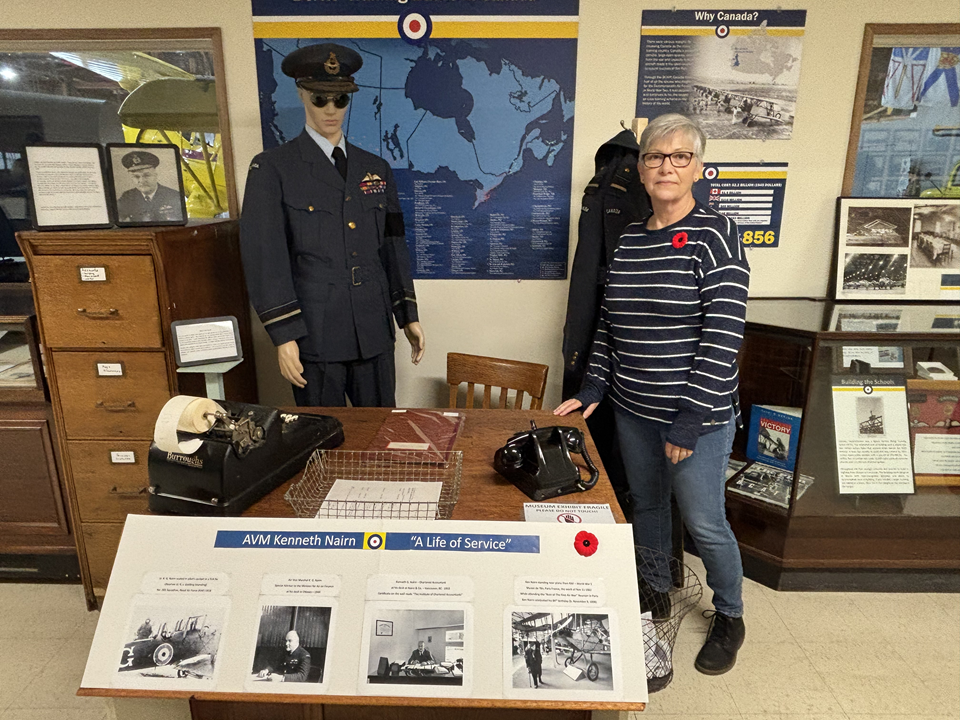
Brandon’s Commonwealth Air Training Plan Museum (CATPM) has unveiled a new exhibit on Remembrance Day highlighting the contributions of a Manitoba veteran during the First and Second World Wars.
The exhibit tells the story of Vice-Marshal Kenneth Gordon Nairn, who served as a pilot during the First World War before taking on a key financial role in the Royal Canadian Air Force (RCAF) during the Second World War.
“We have his letter, documents, boots, headgear and photos to really share his story with the public,” said Lisa Dutton, head researcher at CATPM, who spent more than four months researching Nairn’s life.
Nairn was born in Scotland and immigrated to Canada with his family when he was 12.
After completing his schooling, he joined Lord Strathcona’s Horse in 1916 and served in the trenches of France during the First World War before transferring to the Royal Flying Corps.
Despite having no previous flying experience, Nairn quickly demonstrated his abilities and caught the attention of his superiors.
“He had two months of experience and then started training pilots,” Dutton said.
His performance in aerial combat was also impressive.
“From the end of September 1918 until November 10, 1918, he flew 25 missions and shot down five enemy aircraft. The air force had regarded him highly,” said Dutton.
She added that German aircraft made several attempts to shoot him down, but he managed to evade them all. His squadron had also never seen a German pilot bail out of an aircraft he had shot down.
Following the First World War, Nairn completed his education as an accountant before moving to British Columbia.
His financial expertise would later play an important role during the Second World War. Nairn helped develop the financial systems needed to support the rapid expansion of the RCAF and the British Commonwealth Air Training Plan.
While his contributions may not have been as visible as those of pilots in the air, CATPM director general Zoe McQuinn said the work was essential to the war effort.
“For every pilot in a plane, you’re talking about ten people on the ground who are getting supported. You can’t have an army without everyone. You can’t have an air force without everyone.”
Nairn retired from military service following the Second World War and continued running his accounting business.
Although much of his story has been documented, Dutton said some details and family connections remain unclear.
“I mean, somebody asked me, ‘Oh, is Nairn Avenue in Winnipeg named after the family?’ I said, ‘I have no idea, but hey, we’ll try to find out.’”
McQuinn hopes someone with a connection to Nairn will eventually visit the exhibit and recognize his story.
“Our job is to help people on that journey of finding information on their loved ones and support them, and sometimes that helps us flesh out the story even more.”